Posts

Film Coursework

Image
OCD  Possible title - ANNA - Symmetrical letters YouTube stories on OCD: https://www.youtube.com/watch?v=EXlMF8mfWsc https://www.youtube.com/watch?v=40t0CmdXKo8 https://www.youtube.com/watch?v=3lvzQWM8BKY Camera Shot Ideas for Storyboard & Script: OCD associated with controlled movements, even counting/blinking/stepping, organised surroundings.  Instead of the pictures completely reflecting the theme of the film, I'm going to make it difficult to watch, e.g. subject being in the first third, instead of the centre, the voiceover cutting off before reaching ten, etc.  Message of the film to break the misconceptions surrounding the disorder. Mixture of centred and off-centred images. Perhaps a cyclical structure? Split screen, action in the first continuing through to the second? Wes Anderson -  https://vimeo.com/89302848  - pouring of the drink down the centre. No non-diegetic music for an uncomfortable feel, trickling of water to shot to have l...
Wong

He brings both Asian sensibility and French New Wave cinematic techniques to each of his stories. As with Wong’s other films such as  Chungking Express,   Days of Being Wild ,  Happy Together  and  Fallen Angels ,  In the Mood for Love  dictates the arbitrary nature of romance and the notion of the ‘missed moment’. He consistently employs a signature ‘parallelling’ and ‘intersecting’ rhetoric in which his characters arbitrarily cross paths.  Wong’s protagonists are most often revealed to be a set of individuals existing within the visual array of urbanity. Wong successfully grants introspective gazes at his characters (usually in sets of twos), exploring their insecurities, personal motives and ultimately the random nature of relationships. Again, Wong’s arbitrary rhetoric finds expression in the poetic and brightly drenched tones of his unique filmic aesthetic, and his much-loved themes of loneliness, isolation, and longing rise to the sur...

City of God, Benny's character arc

https://kecnuneaton-my.sharepoint.com/:p:/r/personal/17phorn25_kinged6nun_ac_uk/_layouts/15/Doc.aspx?sourcedoc=%7B2C530E00-217F-4976-A133-C5C340C7ACC2%7D&file=City%20of%20god%20benny.pptx&action=edit&mobileredirect=true

German Expressionism

German Expressionism Depiction of reality that is widely distorted for emotional effect One of the most popular German expressionism films is  The Cabinet of Mr. Calgary , directed by Robert Wiene who hired Expressionist painters like Walter Reinmann and Hermann Warm to actually paint his sets Conventions Twisted landscapes, insane or evil characters, more morbid plot-lines  External representation of internal emotion – this means that if the main character is in a “dark place” emotionally, then the setting must reflect that  Insanity/Obsession Evil/Insane/Obsessive characters Crime or the criminal underworld Urban settings Jagged lines and banding – often created by painting designs on the set Twisted architecture – such as spiral staircases and ominous arches Chiaroscuro – extreme lighting that incorporates dark shadows and bright patches of light, typically associated with Film Noir Silent – intertitles are used to fill in important dialogue. Howe...

Auteur Presentation Reflection

On my presentation, I think I went into enough detail when talking not only about the themes of Lynch's films, but also about certain themes in general - such as surrealism. It was important for the listener to have no misconceptions on surrealism as I went into lots of detail on how it influenced Lynch's work, and how this style greatly supports the argument that he is an auteur. I also used quotes from articles online and from the documentary David Lynch: The Art Life , therefore using more than just my own opinion to back up my argument. These quotes are easily identified within the PowerPoint as I've highlighted them in red. The analysis I feel is in-depth, for example - I have mentioned Lynch's fear/struggle with parenthood several times and how it's inspired characters in his films, while also explaining some sources that may have caused him to create characters such as these, e.g. his own father. An important aspect of what makes an ...

Winter's Bone Style

Due to the independent style of Winter's Bone, it address more niche topics that require active spectatorship. For example, the scene in which the sheriff explains the situation with Ree's father requires this type of spectatorship. It's emotional and extremely tense, and this atmosphere is supported by the diegetic sound of the chainsaw which hints at Ree's discomfort. Inception is a mainstream film that, unlike this, doesn't require much thought due to exposition. Some themes in Winter's Bone are: Patriarchy/feminism (but also oppression of men trapped in this role) - Ree doesn't support the stereotypical representation of women in film, and certainly doesn't for women in this society. The archetype of women is that they're 'damsels in distress' and also they need men.  Addiction, specifically Meth Family and loyalty Violation of the law  Film noir  

Riptide, Vance Joy

Vance Joy- Riptide Analysis Intertextuality- In  Un Chien Andalou, the well-known eye slicing scene could've inspired the hand stabbing scene  Action Code-when the suitcase is being packed as it implies travel Enigma Code-'there's this movie that I think you'll like', continues to linger on the back cover before flipping over and revealing the name  Editing- Jump Cut-fast paced editing keeps with the quick strums of the guitar  Connotation-money used as it has the connotations of green, the green then used to convey envy as she's 'the magicians assistant in their dreams'  Denotation-'I was scared of dentists', shows image of a scared women with dental equipment in her mouth looking frightened  Anchorage-'and starting conversations', image of a book titled 'techniques of photographing girls' Cultural Code- Cowboys, representation of women, based on the way they look and objectified    Semantics Code- Ge...

Social and Production Context of Winter's Bone

https://www.popoptiq.com/interview-john-hawkes-winters-bone/   '... she [Debra Granik ] couldn’t shoot it anywhere else, she couldn’t pretend to be somewhere else but it was a story that was so embedded in a specific area...'    I like how the director was persistent on having it shot in the same location as it is in the novel, as this allows the film to have the truest demonstration of its social structure to show its audiences. It also benefits the film as it means it's loyal to the book; no changes have to be made with the setting so prevention of a changed storyline has likely been avoided. Due to it being accurate, it furthermore warrants positive feedback from the reader portion of the audience carried from the novel.    '...a lot of people weren’t professional actors who were local people in the movie... '    This enforces the idea of keeping it authentic, and means the performance of the characters is as it would be in Mi...

Evaluation

Overall, I was happy with the end product of our film, however I felt by only having a week that the quality of the content was rushed and we were unable to achieve what we set out to do. For example, we had intended to create a linear narrative and did, but it wasn't entirely clear that was happening. To fix this, I would add fades in and out during the editing process. Another problem I encountered was being available for the filming. My timetable often didn't correspond with the other people and actors in my group, so if I do it again I will make sure I have absolutely no responsibilities after college so I'm available. In the exposition, the combination of establishing shots and close-up shots were a bit shaky, so in future I will use a tripod to ensure its professional looking. What I felt was well thought out, however, was the mise-en-scene such as the red nails. Red symbolizes both lust and danger which worked well with the storyline as it starts out with a romantic ...

Final Film

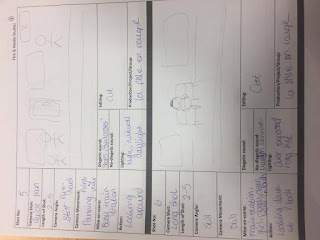
Storyboard

Image

Cinematic Ideas

Cinematic Ideas Mise-en-scene Train station, many medium close-up of 'mind sign' to signify how her mind isn't all there. Clothing for the girl has a timeless feel; accessories such as neckerchief and beret worn by her. The boy wearing smart-casual clothing such as a shirt buttoned to the top. The general colour scheme of the short film consisting of a nude palette, with pops of red from her make-up. The props include the book which is important as it's the cause of their first encounter, and also earphones in which the dietetic sound of the music reflects how he feels about the girl.  Lighting High-key lighting throughout the beginning of the train station shots to give the illusion that the genre is romance. Next scene in the girl's bedroom to be lit with fairy lights that create a romantic atmosphere, and to also reflect how the events get darker as the film progresses. The final scene at the train station to have low-key lighting as it's set in ...

Mood Board

Image

Synopsis

Our Short Story The story begins at the train station and our main characters are facing each other on different platforms. The boy’s body language clearly indicates that he likes the girl, but she’s too immersed in her book to realise he’s even looking at her. A train then speeds past and blocks his view of her momentarily. When the train has gone, he goes to look at her once again but discovers that she’s moved on and accidentally left her book in the place she once sat. He keeps the book and returns it to the girl the following day, only this time the book has a note poking out of it with his number scrawled upon it. Soon after this development, our girl is seen applying make-up in a fancy outfit which suggests she’s going out; her joyful and smiling disposition showing how excited she is to be finally meeting with the boy from the train station. On the walls of her room, pictures of females such as Courtney Love and Marilyn Monroe can be seen, and the lighting from her fairl...

The Place Beyond the Pines Analysis

The Place Beyond the Pines Analysis   An establishing shot of a fairground opens the clip so to inform the audience of the location and also to help create an atmosphere. Although the high-key lighting would suggest a sense of light-heartedness, and the mise-en-scene of the bright, colourful fairground rides would evoke the feeling of optimism, these features actually work to contrast against the severity of the next cut. The diegetic cries of childish laughter begin to disperse as the non-diegetic sound of a voice-over begins to help transition into the next scene.    Once inside the room, close-ups and shot-reverse-shots are used to show the two characters conversing. Our first impressions of the man aren't high as the use of depth-of-field highlights his multiple rugged tattoos and focuses on the cigarette being smoked. By having him smoke it there in front of his current employer, I feel it implies that not only does he disregard authority, but additionally,...